
The Challenge
Many organizations need a simple, reliable way to analyze consolidated data coming from multiple systems—such as ERPs, marketing platforms, and payroll applications. Typical use cases include analyzing a customer’s purchasing patterns or comparing vendor pricing across divisions, business units, and regions.
However, producing consolidated reports across these systems presents several challenges:
Data silos and extraction complexity
Transactional data resides in separate databases, often using different technologies. Extracting this data into a unified reporting environment can be complex, fragile, and time-consuming.
Inconsistent schemas and identifiers
Raw data is stored in different tables, with varying column names, formats, and data types. Entity identifiers—such as customer or vendor names and IDs—rarely align across systems, making cross-system reporting difficult.
Complex data blending rules
Combining similar data from different systems requires sophisticated transformation and normalization logic. For example, one system may store quotes and invoices in a single table, while another splits each transaction type into separate tables. Aligning these structures for consistent reporting adds significant complexity.
Ongoing system changes
Over time, source systems are upgraded, customized, or reconfigured, often changing internal table structures and data-capture logic. These changes can break existing reports and require continual maintenance.
Data Warehousing and DFT+ to the Rescue
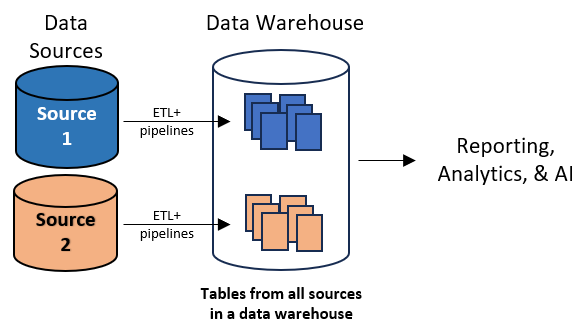
Option 1: Single database for reporting
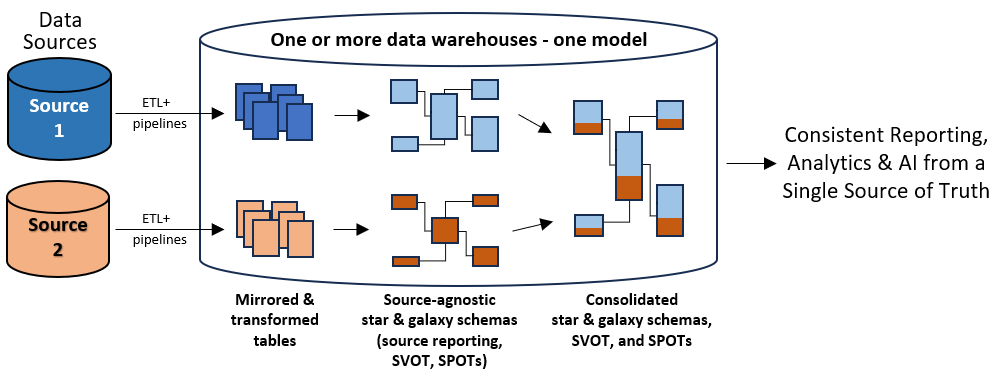
Option 2: Consolidated reporting with DFT+
Option 1: Single Database for Reporting (Baseline)
-
Use ETL+ pipelines to extract and load data from each source into a single reporting database.
-
Load each source into its own schema to preserve original structures and reduce coupling.
-
Apply basic transformations and data cleanup as needed.
-
Enables faster report development by querying one database, but reporting remains source-specific.
-
Cross-source analytics require manual joins, custom logic, and ongoing maintenance.
Best for: quick consolidation, departmental reporting, or early-stage BI.
Option 2: Consolidated Reporting with DFT+ (Recommended)
Click here to learn more about DFT+: DFT+ Modeling - Source Agnostic
-
Use ETL+ pipelines to ingest, normalize, and transform data from all sources.
-
Create source-agnostic star and galaxy schemas that standardize business entities and metrics. DataSelf has DFT+ which is a framework to normalize Dimensions, Facts, and Time across source systems.
-
Support both individual source reporting and cross-source consolidation from the same model.
-
Establish SVOT (Single Version of the Truth) and SPOTs (Single Point of Truth) to ensure consistent definitions across reports, analytics, and AI.
-
Decouple analytics from source-system changes, upgrades, and schema drift.
Delivers: consistent reporting, analytics, and AI from a single, trusted model—regardless of how many sources or warehouses are used.
Keywords: data migration tools, data consolidation, Acumatica, Sage 100, Sage 300, Sage 500, Sage Intacct, Sage Pro, Sage X3, Microsoft Dynamics 365 (AX, GP, NAV, SL), NetSuite, QuickBooks, QuickBooks Online, CSV, MS Access, MS SQL Server, Oracle, DB2, Pervasive, Providex, MS FoxPro, PostgreSQL, MySQL.