
Many reporting challenges—such as normalized ERP databases, complex business rules, reporting across multiple business areas, blending multiple systems, and supporting AI—have a common solution: a well-designed dimensional data model.
Star and galaxy schemas organize business data into reporting-friendly facts and dimensions that simplify queries, centralize business rules, improve performance, and provide a trusted, reusable foundation for traditional reporting, BI, dashboards, and AI.
DFT+ Star Schemas
Key benefits of a well-designed Star Schema include simplicity, flexibility, high performance, and a single version of the truth. It organizes data around a single fact table connected directly to its related dimension tables, making reports and data analysis easier to build, understand, maintain, and optimize for performance.
A star schema focuses on a single business process, such as Sales, Purchasing, Inventory, or General Ledger. Each dimension is directly related to the central fact table, creating a simple, intuitive structure that is ideal for most dashboards and reports.
Star schemas are easier to maintain, deliver excellent query performance, and provide a solid foundation for self-service analytics. As reporting requirements expand to span multiple business processes, multiple star schemas can be combined into a galaxy schema by sharing common dimensions.
Simplified Example
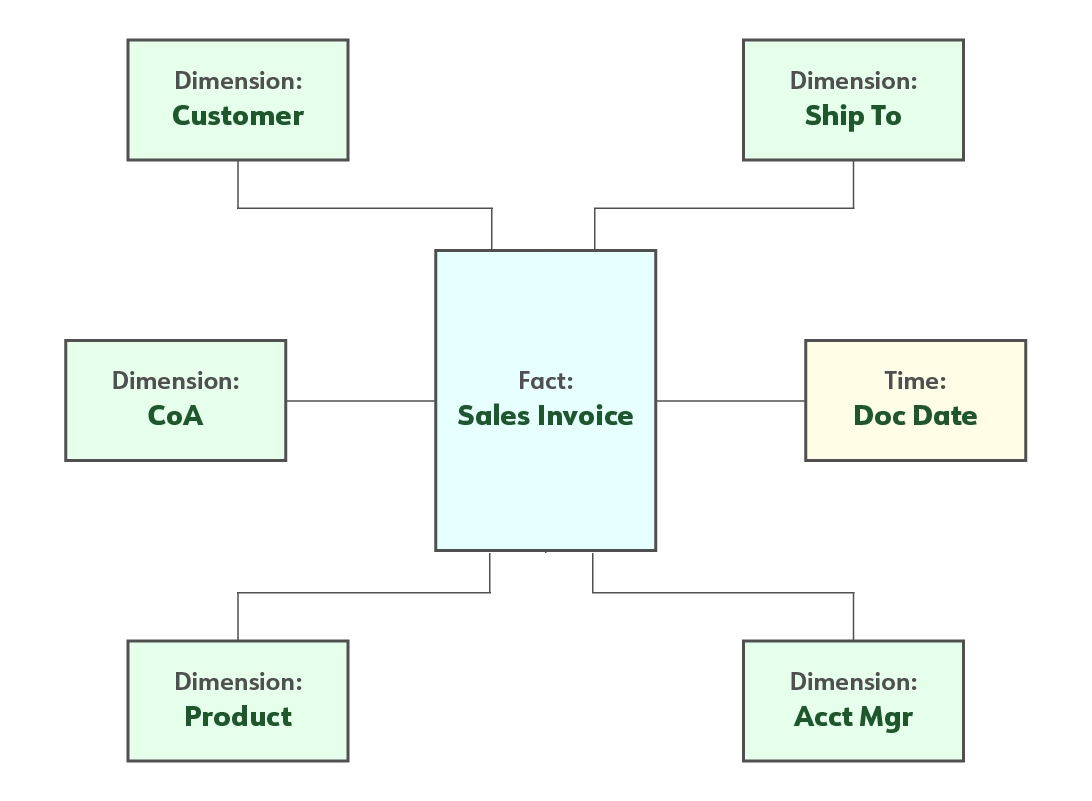
This example illustrates a single fact table surrounded by its related dimension tables, such as Customer, Product, Salesperson, Time, and Geography.
Example of a Production Star Schema
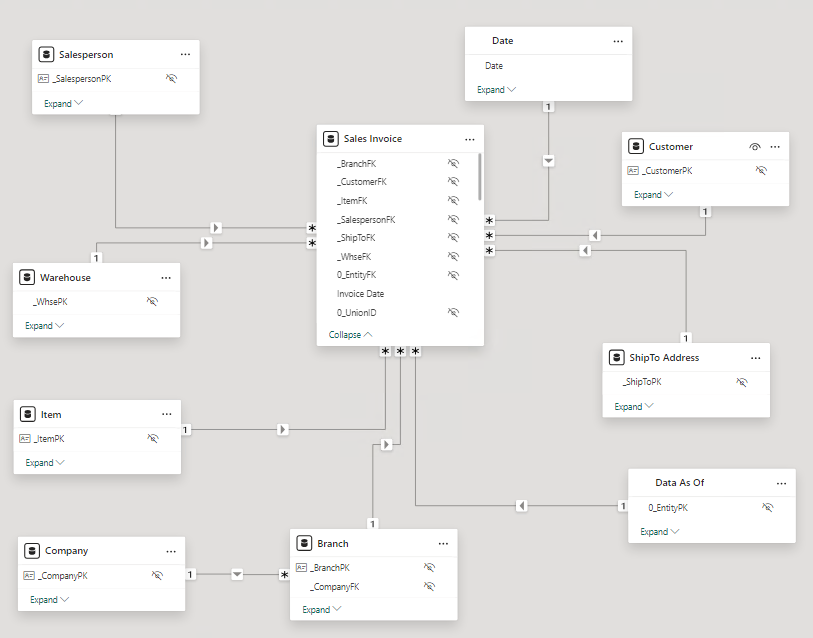
The following exemplifies how the Sales Invoice DFT+ tables are linked in DataSelf’s out-of-the-box templates in a star schema arrangement. This model works in reporting tools such as Power BI, Tableau, Excel, and AI tools such as Claude and ChatGPT.
DFT+ Galaxy Schemas
A key benefit of a galaxy schema is its ability to support reporting across multiple fact tables using shared dimensions within a single report. This enables users to analyze different business processes—such as sales, purchasing, inventory, and finance—from a consistent, unified perspective.
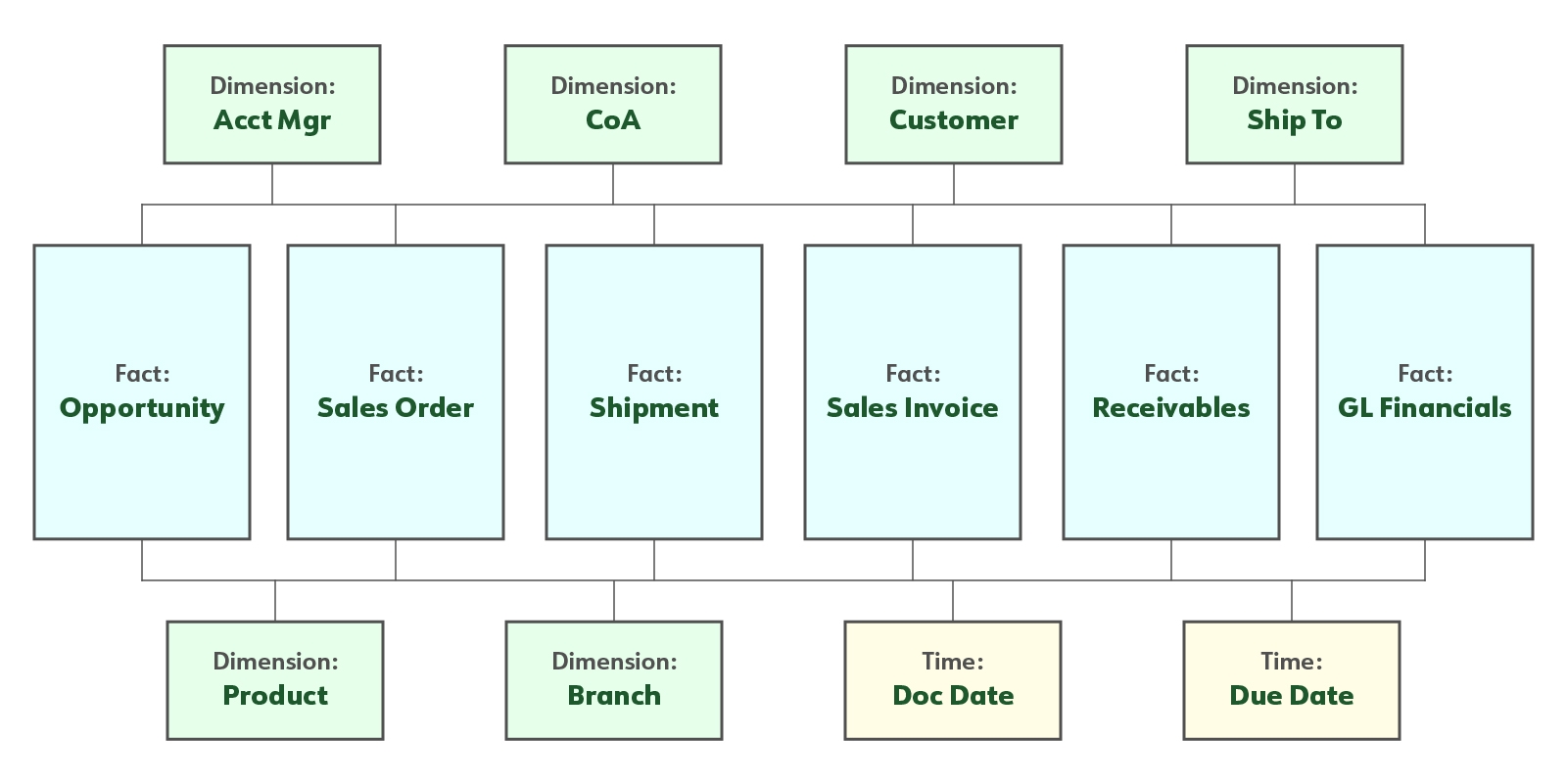
In a galaxy schema, not every shared dimension is necessarily related to every fact table. For example, the Chart of Accounts (CoA) dimension may be linked to financial fact tables but not to an Opportunity fact table, since opportunities typically do not have accounting entries.
This flexible design allows each fact table to include only the dimensions that are relevant while still providing a consistent analytical model across the data warehouse.
Simplified Example
This example illustrates six fact tables sharing six dimension tables and two time dimensions.
Example of a Production Galaxy Schema
The following exemplifies how DFT+ tables are linked in DataSelf’s out-of-the-box templates in a galaxy schema arrangement. This works in reporting tools such as Power BI, Tableau, Excel, and AI tools such as Claude and ChatGPT.
Key Words: single source of the truth, ETL templates, data warehouse templates, analytics templates, tds, tdsx, twb, twbx, pibx.