
DataSelf Value Proposition
Organizations generate vast amounts of data across ERP, CRM, eCommerce, payroll, spreadsheets, and other operational systems. While these systems excel at processing transactions, they are not optimized for analytics, reporting, or AI consumption.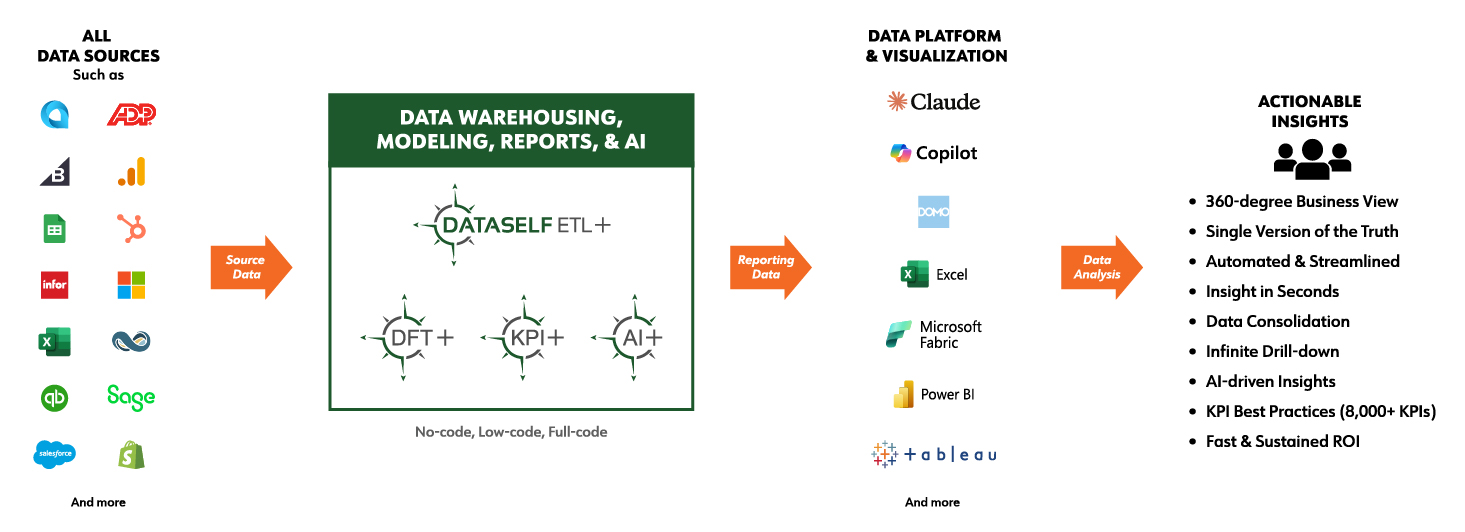
DFT+ (Dimension, Fact, and Time) is DataSelf's data modeling framework that transforms raw operational data into business-ready analytical models. By organizing data into dimensions, facts, and time-based structures, DFT+ creates a consistent and scalable foundation that can be consumed by reporting, analytics, and AI platforms.
Purpose-Built for Decision Making
Transactional systems are designed to record business events. Analytics systems are designed to answer business questions.
DFT+ bridges this gap by converting complex operational data into simplified business models that are easier to understand, query, analyze, and maintain. The resulting models provide a consistent structure for reporting across departments, business functions, and technologies.
This dimensional approach helps organizations establish a Single Version of the Truth (SVOT) by standardizing business definitions, calculations, hierarchies, and relationships.
Optimized for Modern Decision Support Systems
DFT+ models are designed to feed a wide range of analytics, reporting, and AI technologies, including:
-
ChatGPT
-
Claude
-
Domo
-
MS Excel
-
Microsoft Fabric
-
Power BI
-
Tableau
-
Custom applications
-
Data science platforms
Because the business logic resides within the data model, organizations can leverage multiple reporting tools without rebuilding calculations and relationships for each platform.
AI Starts with Trusted Data
AI systems depend on accurate and well-structured information. DFT+ provides AI-ready data models that help AI platforms understand business entities, transactions, relationships, metrics, and historical context. By delivering consistent dimensions, facts, and time intelligence, DFT+ improves the quality of AI-generated insights and recommendations.
This foundation supports:
-
AI assistants and copilots
-
Natural language querying
-
MCP-enabled AI platforms
-
Predictive analytics
-
Machine learning initiatives
-
Generative AI applications
One Model, Many Consumers
One of the key advantages of DFT+ is that the same dimensional model can serve multiple business needs simultaneously.
The same DFT+ model can power:
-
Executive dashboards
-
Operational reports
-
Self-service analytics
-
KPI scorecards
-
AI assistants
-
Advanced analytics
-
Future reporting and AI technologies
Organizations model the data once and reuse it across their entire analytics ecosystem.
Business Benefits
Organizations leveraging DFT+ typically experience:
-
Faster time to insight
-
Reduced reporting complexity
-
Consistent KPI definitions
-
Improved data governance
-
Easier maintenance and support
-
Better AI outcomes
-
Higher user confidence in data
-
Greater return on analytics investments
Conclusion
DFT+ transforms operational data into a dimensional model optimized for analytics, reporting, and AI. By organizing information into Dimensions, Facts, and Time structures, DFT+ simplifies reporting development, standardizes business logic, and provides a scalable foundation for business intelligence and AI-driven decision-making.