
DataSelf Transforms Source Data into Trusted Data
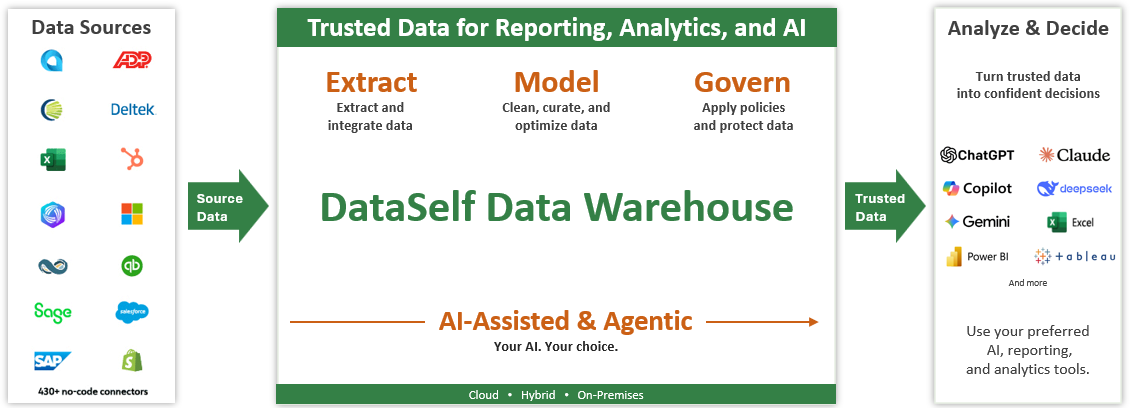
It extracts and integrates data from ERP, CRM, and other systems; cleans, curates, and optimizes it into business-ready models; and applies governance and security policies. The resulting data warehouse works with your preferred AI, reporting, and analytics tools.
Data Warehousing for Mid-sized Organizations
DataSelf delivers AI-powered data warehousing, automated modeling, and business intelligence for organizations that need enterprise-grade analytics without their complexity, overhead, and costs.
The Big Picture
-
Extract: Connect, extract, and consolidate data from ERPs, CRMs, databases, files, APIs, and other sources. DataSelf provides 430+ no-code connectors, plus access to thousands of additional sources through low-code and full-code integrations—with AI assistance.
-
Model: Clean, curate, optimize, and organize data into reporting-ready star and galaxy schemas using DataSelf DFT+. Providing a robust and consolidated single version of the truth.
-
Govern: Apply consistent business definitions, access policies, quality controls, and data protection to deliver secure, trusted data.
-
AI-Assisted and Agentic: AI can assist users in designing, configuring, documenting, operating, and analyzing the data warehouse. Agentic capabilities can also perform authorized tasks across the data lifecycle. Your AI. Your choice: full-data, metadata-only, or no AI.
Single Version of the Truth (SVOT)
DataSelf DFT+ centralizes business logic into governed models and Single Points of Truth (SPOTs), helping organizations eliminate inconsistent metrics spread across reports, spreadsheets, and departments.
Using star and galaxy schemas, DataSelf delivers scalable and reusable business definitions instantly available across the analytics and reporting layer.
Why DataSelf?
Many SMB and mid-market organizations struggle to understand and justify the cost, complexity, and staffing requirements of modern enterprise data platforms. Platforms such as Snowflake, MS Fabric, Databricks, and Fivetran are powerful technologies, but they often require:
-
specialized data engineering teams
-
extensive custom development
-
ongoing pipeline maintenance
-
manual data modeling
-
complex governance initiatives
-
multiple third-party products
-
difficult-to-predict pricing
DataSelf delivers a more integrated and business-ready approach for SMBs especially ERP-driven organizations. With DataSelf, organizations can accelerate analytics with:
-
DataSelf ETL+ — No-code, low-code, and full-code data integration in a single platform
-
Prebuilt data pipelines for popular ERPs, CRMs, and other systems.
-
Automated DFT+ data modeling
-
Power BI, Tableau, Excel, AI (Claude, ChatGPT, etc) integration
-
Decision-ready analytics in hours or days—not months
-
Easy to understand and scale pricing
DataSelf vs DIY Data Engineering Platforms
Many data engineering and data warehouse/data lake platforms offer flexibility and scale, but can require technical teams, custom development, and ongoing maintenance.
DataSelf helps mid-market organizations accelerate such platforms and analytics with prebuilt connectors, automated governed modeling, KPI templates, and BI & AI-ready data structures.
|
Capabilities |
Snowflake, MS Fabric, Databricks, Fivetran |
DataSelf |
|---|---|---|
|
Mid-market focused (SMB) |
Not typical |
Yes |
|
Open platform (works with complementary technology) |
Yes |
Yes |
|
Portability (migration to another platform) |
Complex |
Easier |
|
Architecture options |
Primarily cloud-centric |
Cloud, private cloud, on-premises, hybrid, customer or vendor managed |
|
Vendor lock-in |
Moderate |
Low |
|
Requires dedicated data engineers |
Typically required |
Typically unnecessary |
|
ETL/ELT (extract, transform, load) |
Yes |
Yes (includes ETL+) |
|
Prebuilt ERP pipelines |
Limited |
|
|
Automated governed modeling |
Custom initiative |
DFT+ (Customizable) |
|
KPI templates |
Minimal |
KPI+ (industry-specific, best practice 8,000+ KPI library) |
|
Single version of the truth |
Custom initiative |
DFT+ (Customizable) |
|
Star & galaxy schemas |
Custom initiative |
DFT+ (Customizable) |
|
AI-assisted modeling & governance |
Large enterprise focus |
|
|
Fabric Power BI / Tableau / AI ready |
Custom initiative |
|
|
Initial platform deployment |
Minutes to hours |
|
|
Time to value |
Months |
|
|
Business-ready out of the box |
Custom initiative |
Yes |
|
Business model |
Platform (DIY) |
|
|
Pricing model |
Pricing complexity |
DataSelf Architecture
DataSelf delivers a flexible, decoupled analytics architecture designed to evolve with your business—not lock you into a single cloud, visualization tool, or proprietary ecosystem.
Built for SMB and mid-market organizations requiring enterprise-grade analytics, DataSelf supports scalable deployments across Microsoft SQL Server, Azure SQL, Fabric, AWS, private cloud, and on-prem environments.
The result: governed, secure, and future-ready analytics infrastructure that protects your long-term BI investments while accelerating time to insight.
Flexible Deployment Options
Organizations can leverage:
-
DataSelf-hosted services running on Azure and AWS
-
Their own Microsoft Azure, Microsoft Fabric, AWS, Google Cloud, private cloud, or on-prem infrastructure
-
Hybrid and multi-source architectures consolidating data across multiple systems and environments
Decoupled and Scalable Architecture
DataSelf’s architecture is intentionally decoupled to provide:
-
Long-term scalability and operational stability
-
Flexible integration with Power BI, Tableau, Excel, AI platforms, and other analytics tools
-
Freedom to evolve visualization, storage, and compute platforms independently over time
-
Reduced vendor lock-in and better protection of analytics investments
Security and Compliance Flexibility
DataSelf supports deployment models designed to align with a wide range of security and compliance requirements, including:
-
HIPAA-oriented environments
-
FedRAMP and government-oriented architectures
-
Private cloud and fully isolated deployments
-
On-premises environments with client-controlled security policies
Architecture That Evolves With Your Business
Organizations can begin with a simpler architecture optimized for rapid deployment, faster time to value, and lower complexity. As analytics maturity, data volume, and business requirements evolve, the architecture can be reconfigured, ported, and expanded without requiring a full platform replacement or rebuilding the analytics solution from scratch.
This flexibility allows organizations to adapt infrastructure, cloud platforms, storage, compute, and visualization technologies over time — without being locked into a single architectural decision.
DataSelf Complementing Microsoft Fabric