
Overview
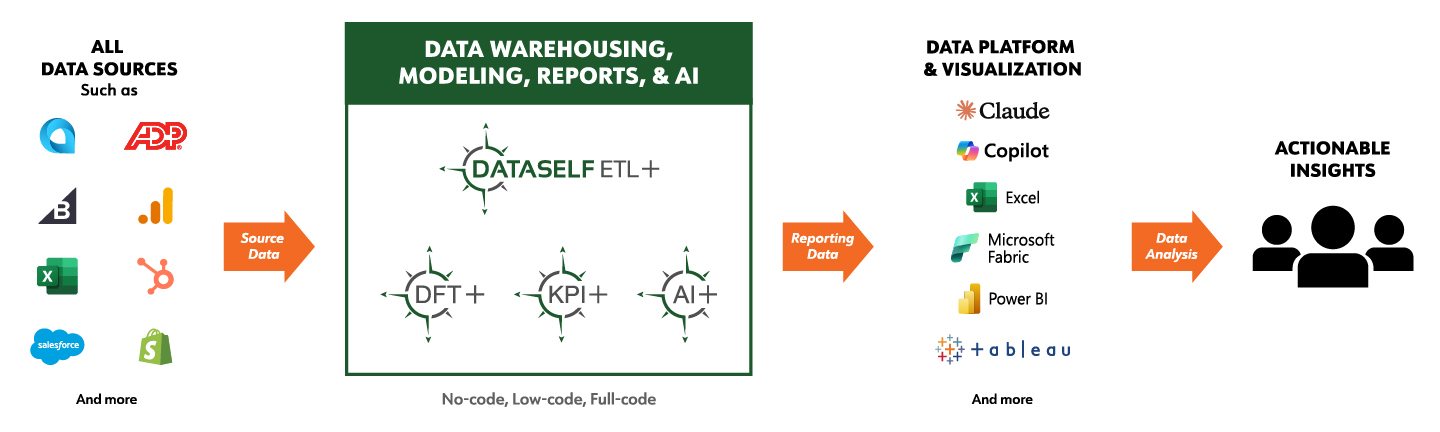
Users can set up an MCP Server to connect AI tools and agents to the DataSelf data platform for Acumatica and other systems. Once connected, they can use AI assistants for data modeling, exploration, SQL generation, analysis, and insight discovery using trusted DataSelf data.
DataSelf MCP can connect DataSelf environments to leading AI tools such as Claude, ChatGPT, Microsoft Copilot, Gemini, Llama, and others. This allows organizations to use their AI assistant of choice while working from a governed analytics foundation.
MCP extends DataSelf’s data warehousing, data lake, Power BI, Tableau, and analytics capabilities by allowing AI assistants to securely read, query, and reason over approved DataSelf data models. Instead of building custom integrations for every source system, organizations can use DataSelf MCP to ask natural-language questions, explore trends, validate metrics, and accelerate reporting workflows with consistent, BI-ready data.
What DataSelf Enables
With DataSelf MCP, Acumatica users can connect AI assistants and agents to trusted DataSelf data models instead of asking AI to interpret raw ERP tables directly. This allows business users, analysts, and technical teams to ask natural-language questions, explore metrics, generate SQL, validate trends, and accelerate reporting workflows from a governed analytics foundation.
Instead of starting with complex Acumatica schemas, joins, and business logic, the AI works from DataSelf’s curated data warehouse and modeled reporting layer.
Example AI Prompts
Users can ask questions from their Acumatica and other systems such as:
-
Show sales by year from the DataSelf data warehouse.
-
Show sales by customer for the last 12 months.
-
Which customers had the largest sales decline this year?
-
Compare sales by product class and salesperson.
-
Show gross profit trends by month.
-
Which items are growing fastest?
-
Summarize AR aging by customer.
-
Find customers with declining order activity.
-
Generate SQL for sales by year.
-
Explain this KPI in business terms.
-
Create a chart showing monthly sales trends.
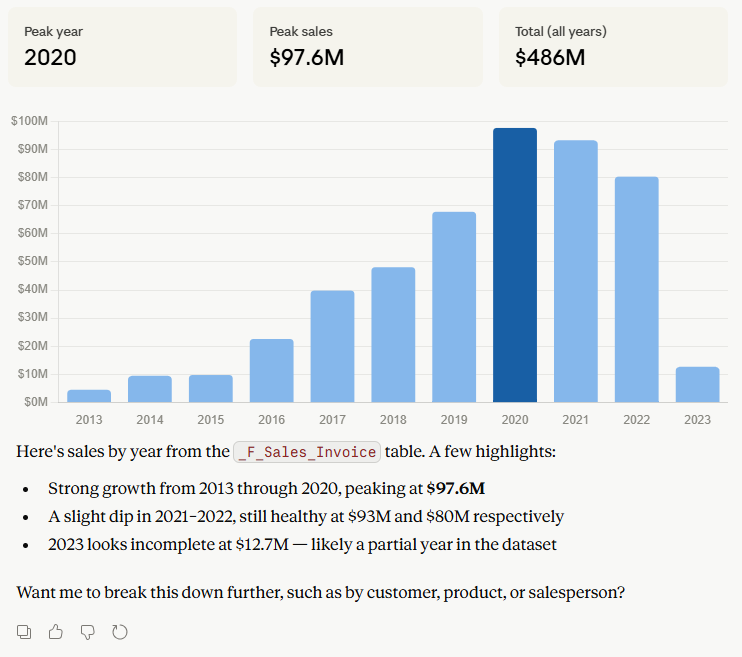
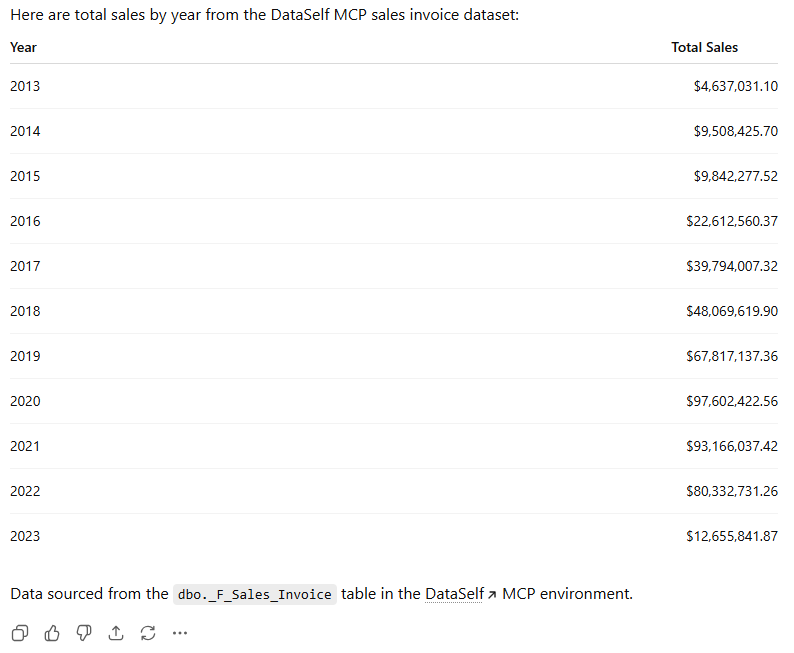
Here’s a prompt and AI answers: “Show sales by year from DataSelf DW”
Why Use DataSelf MCP Instead of Connecting AI Directly to Acumatica?
AI tools can generate useful answers only when they have access to clean, governed, and well-modeled data. Connecting AI directly to raw ERP tables can create challenges because ERP data structures are often complex, highly normalized, customized, and difficult for AI tools to interpret accurately.
DataSelf MCP gives AI tools access to a more analytics-ready foundation:
|
Raw Acumatica Data |
DataSelf MCP |
|---|---|
|
Complex ERP tables and joins |
Curated analytics models |
|
Business logic may be scattered across reports |
Centralized business rules |
|
Harder for AI to understand relationships |
Modeled facts, dimensions, and KPIs |
|
Higher risk of inconsistent answers |
Governed Single Version of Truth |
|
Requires more technical knowledge |
Natural-language analytics experience |
|
Slower path to business insight |
Faster, repeatable analysis |
|
Performance hit in Acumatica system |
No performance hit in Acumatica |
|
AI queries can take a long time to run, no matter when using OData or direct SQL connections |
AI queries run in seconds |
|
High AI token consumption |
Low AI token consumption |
|
Harder to control data governance |
Easier enterprise-grade data governance |
Security and Governance
DataSelf MCP is intended to provide controlled access to trusted analytics data. Organizations should configure MCP access using appropriate security practices, including read-only database permissions, approved tables or views, user access controls, and monitoring of AI-assisted queries.
Recommended practices include:
-
Use read-only access for AI tools.
-
Expose governed DataSelf views instead of raw operational tables.
-
Limit access to approved business areas.
-
Avoid exposing sensitive fields unless required.
-
Review generated SQL before using it in production workflows.
-
Use DataSelf’s curated models as the trusted analytics foundation.
Who Benefits?
Business Users: Can ask natural-language questions and receive faster answers without needing to understand database schemas or write SQL.
Analysts: Can explore data, generate draft queries, validate trends, and accelerate report development.
Executives: Can get summarized insights from trusted data models without waiting for custom report development.
Data and IT Teams: Can reduce ad hoc reporting requests by giving users a governed AI interface to curated analytics data.
Data Scientists: Can access curated, governed, analytics-ready datasets for modeling, forecasting, experimentation, and advanced analysis, reducing time spent on data preparation.
Important Note About Validation
AI-generated answers should be validated against approved DataSelf QA Process & Single Version of the Truth. This is important especially during implementation, model changes, or new reporting use cases.
The advantage of using DataSelf is that AI tools interact with governed data models that have already been reconciled through DataSelf QA reports. Once a business area model, such as sales by customer or sales by period, has been validated, the related AI-assisted answers and reports are built from that same trusted foundation.
MCP Servers for DataSelf
Summary
DataSelf MCP extends DataSelf Analytics for Acumatica by making trusted BI data accessible to modern AI assistants and agents. By combining Acumatica data, DataSelf’s governed analytics models, and MCP-based AI connectivity, organizations can move from static reporting to conversational, AI-assisted analytics while maintaining control, consistency, and trust in their data.